http://www.washingtonpost.com/opinions/seeking-counsel-from-a-wise-man-of-the-arab-world/2011/11/23/gIQAkMe8wN_story.html
David Ignatius is a columnists who writes about foreign affairs. This week he wrote about the aftermath of the "Arab Spring" and what Saudi Arabia's foreign minister, Prince Saud al- Faisal, had to say about it. Ignatius emphasizes the importance of listening to people who have wisdom: the elders. That is why he is talking to al- Faisal who has been foreign minister for around 36 years. He views the revolts as positive change and believes that conflicts arise because the governing bodies to not recognize the will of the people. Both Ignatius and al- Faisal realize the amount of uncertainty in the outcome of the revolts in multiple countries, but they know it all depends on the people.
Saturday, November 26, 2011

Sunday, November 6, 2011
Columns Synthesis: My POV
As of December 2010 the whole world is watching the so called "Arab Spring" that is happening all across the Middle East. It is important to recognize the efforts that have spread through many different countries, starting with Egypt. As dictators are being overthrown, people are asking "what now?" I have faith in the democratic ideals of the rebels; it is easy to see that Egypt, Libya, and other nations are in the process of creating a new, fair system of government with the input of many different voices. The protests started because of a financial upset that made people realize the inefficiency and controlling nature of their government. The democratic process will take time but in the long run things will stabilize. Of course, the whole Middle East region is not free yet, but after these revolutions it is only a matter of time before all nations have citizens who agree with their government.
Sunday, October 30, 2011
Columnist Opinion #4
http://www.leaderjournal.com/opinions/x671076089/Jared-Olar-Will-Arab-Spring-produce-better-leaders
Jared Olar applauds the achievements of the revolutions in Tunisia, Egypt, Libya, and other Middle Eastern countries. But he thinks the hope of freedom is fragile at the moment; it could bring improvement or a "different kind of bad". He uses Egypt as an example; since the revolution violence against Coptic Christians has sprung up where it never existed before.
Jared Olar applauds the achievements of the revolutions in Tunisia, Egypt, Libya, and other Middle Eastern countries. But he thinks the hope of freedom is fragile at the moment; it could bring improvement or a "different kind of bad". He uses Egypt as an example; since the revolution violence against Coptic Christians has sprung up where it never existed before.
Saturday, October 22, 2011
Columnist POV #3
http://www.reuters.com/article/2011/10/20/idUS232058400720111020
James Carafano believes that freedom will not fully come to the Middle East without Iran falling as well. He uses previous American policies towards Iran to exemplify that tolerant behavior has never worked. He says the only way to solve Iran's leadership problems is to give freedom to the people, like what has happened in other countries such as Egypt and Libya. In addition, this freedom must come FROM the people; but Carafano complains the U.S government is not doing enough to achieve this goal. His targets his audience, the U.S government by criticizing their policies in the hope that they will change.
James Carafano believes that freedom will not fully come to the Middle East without Iran falling as well. He uses previous American policies towards Iran to exemplify that tolerant behavior has never worked. He says the only way to solve Iran's leadership problems is to give freedom to the people, like what has happened in other countries such as Egypt and Libya. In addition, this freedom must come FROM the people; but Carafano complains the U.S government is not doing enough to achieve this goal. His targets his audience, the U.S government by criticizing their policies in the hope that they will change.
Saturday, October 15, 2011
Differing Perspective- Columnist 2
http://www.washingtonpost.com/opinions/around-the-world-rage-against-the-elites/2011/10/11/gIQA0UkykL_story.html
David Ignatius believes the uprisings in the Middle East could have been a reaction to the financial crisis in 2008. The riots started among young people because they were unemployed and even in America this displeasure is surfacing. He mentions the protests in Greece, Britain, New Delhi, and America. He sees these revolutions as economic AND political, not just as political like the previous columnist, Turki, believes. In addition to economic troubles, Ignatius sees all the recent revolutions around the world as connected by resentment of the elite. Even Indian and Chinese citizens have been protesting againt corruption.
David Ignatius believes the uprisings in the Middle East could have been a reaction to the financial crisis in 2008. The riots started among young people because they were unemployed and even in America this displeasure is surfacing. He mentions the protests in Greece, Britain, New Delhi, and America. He sees these revolutions as economic AND political, not just as political like the previous columnist, Turki, believes. In addition to economic troubles, Ignatius sees all the recent revolutions around the world as connected by resentment of the elite. Even Indian and Chinese citizens have been protesting againt corruption.
Saturday, October 8, 2011
"Arab Spring" Columnist 1
http://gulfnews.com/opinions/columnists/dark-challenges-restrict-arab-spring-1.887405
Fawaz Turki believes that situations after the uprisings in the Middle East are hard to predict. They were political revolutions, so they will not heal quickly. He cites 2 authors who, in the 1900s, tried to predict what would happen in the Middle East. Turki points out that they were very off the mark. He uses the example of Egypt; After their uprising, there still isn't peace or security. The armed forces are still censoring what the media puts out; they didn't want press coverage of Mubarak's trial. So, until we let things unfold a bit more, it will be hard to predict when freedom will come.
Fawaz Turki believes that situations after the uprisings in the Middle East are hard to predict. They were political revolutions, so they will not heal quickly. He cites 2 authors who, in the 1900s, tried to predict what would happen in the Middle East. Turki points out that they were very off the mark. He uses the example of Egypt; After their uprising, there still isn't peace or security. The armed forces are still censoring what the media puts out; they didn't want press coverage of Mubarak's trial. So, until we let things unfold a bit more, it will be hard to predict when freedom will come.
Saturday, September 24, 2011
Visual Rhetoric :)

http://farm5.static.flickr.com/4131/4847016266_b8c5a78e18.jpg
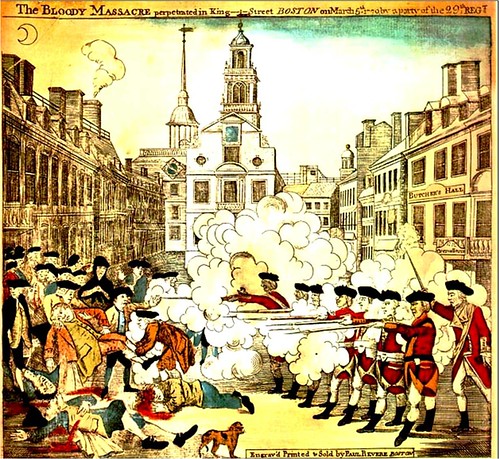
This picture is an engraving done by Paul Revere showing the Boston Massacre of 1770. It contrasts the British soldiers and the American rebels by showing the soldiers in bright red uniforms that is very different from the colonists' regular clothes.
Sunday, September 18, 2011
Editorial
http://www.washingtonpost.com/opinions/new-sarah-palin-tell-all-tells-us-more-about-ourselves/2011/09/16/gIQAXfSXYK_story.html
This editorial criticizes the author, Joe McGinniss, of the book "The Rogue: Searching for the Real Sarah Palin". He claims it is unfair for anyone to have their lives scrutinized to this level for anyone to see and ridicule. Colbert King, the writer of the editorial, doesn't approve of the information of Palin's past romantic life just because she made statements against sex-education and promoting abstinence education. He condemns the attitude that anything goes for figures that Americans dislike, while we pretend to have freedom and privacy.
Sunday, September 11, 2011
Current Events
http://www.economist.com/blogs/baobab/2011/09/famine-horn-africa-0
Due to the famine and drought in the Horn of Africa, many African businesses and charities are sending in help and support. South Africa and the Kenyan organization Africans Act 4 Africa have donated lots of supplies and money. America has also attempted to help by proposing long term funding for African agriculture. But the famine is causing problems for Kenya because of the 400,000 people populating a Somali refugee camp. Nevertheless, aid continues to pour in to try to reverse the horrible conditions faced by the people affected by the famine.
Due to the famine and drought in the Horn of Africa, many African businesses and charities are sending in help and support. South Africa and the Kenyan organization Africans Act 4 Africa have donated lots of supplies and money. America has also attempted to help by proposing long term funding for African agriculture. But the famine is causing problems for Kenya because of the 400,000 people populating a Somali refugee camp. Nevertheless, aid continues to pour in to try to reverse the horrible conditions faced by the people affected by the famine.
Subscribe to:
Posts (Atom)